Friday, November 7, 2014

Sydney & the Melbourne Cup

Town Hall with a beautiful purple blooming Jacaranda tree
We had a great time in Sydney, Australia. In general, we try to avoid big cities - we usually don't enjoy the crowds, smog, cement, and transport that often go with them.  But Sydney is a very different city.

The city is incredibly clean and well-maintained. I never saw any dog poo on the sidewalks and litter was nonexistent. There are recycling bins - a very pleasant change from Thailand. When we passed people, they seemed friendly and would even make eye contact. The sidewalks are large and expansive, and cars always stopped for us at crosswalks.

Wow! Look at the size of this tree!
And the air! It smelled clean! There are large trees everywhere, and the downtown area was very green and filled with big, large parks. As we walked towards the city center, we frequently heard interesting bird calls. Ibis, a large stork-like bird with a long, pointy curved bill, were as common as ducks in Oregon, and they wandered everywhere in the city looking for scraps of food.

The large parks right in the center of the city were one of my favorite things. We would frequently cross through a park to get to a destination, and the bird life was fantastic. We saw a couple large white cockatoos up in the palm trees, and a small green & blue parrot when we went through the botanical gardens. The plant life was amazing and rich with flowers and color.

Our second day, we tagged along on a Free Tour of Sydney, led by our friendly guide, Allie. (Thanks Christina & Tim for the tip about these tours!) We learned about Sydney's history, from a convict prison to a thriving settlement. And, we got to see a horse race! As it happened, we took our tour on the day of the Melbourne Cup race, a gigantic and popular international horse race, with a $3.6 million prize to the winner.

The crowd watching the race
The whole city was on holiday that afternoon to watch the race. There's only one race, and it lasts about 10 minutes, but the entire city takes at least half the day off for it. We watched the race from a packed crowd in front of a huge screen in Martin Place. It was great fun to watch, especially as the winning horse won by quite a lead ahead of the others.

As we finished our tour of the city, we saw multiple bars with men dressed in suits and women in fancy dresses with feathery hair accessories, all drinking and chatting after the race was done. It looked like the party went all the rest of the evening! I had fun sneaking pictures of all the funny hair pieces - some were quite strange looking. I guess it is a "horse racing" tradition to wear these.

See the lady in yellow with the funny hat?
We enjoyed the rest of the sights of the city too of course. :) We wandered through The Rocks, the original birthplace of Sydney's colony and talked to an aboriginal tour guide inside who told us about the native peoples' culture and lives. The Sydney Opera House was beautiful from afar and close up - it looks a lot more "metallic" in pictures, but it really is covered in thousands of bright white ceramic tiles. They gleam in the sun and reflect the light in different ways, and it was great to see the building close up to admire its structure. At the time of its planning, the builders didn't even know how to construct it!

Ibis birds casually strolling the Botanic Garden lawns

A lorikeet

Saturday, November 1, 2014

Day 3 & 4, Similan Islands Log

Dinner on Day 3
By day 3, we were immersed in the routine of the boat. Over the course of 14 dives, my buoyancy control increased tremendously. In diving, buoyancy control means the difference between running into coral, or needing to hold on to something, and just a general feeling of being in control of your body in the water. By day three, I could turn better, avoid obstacles, and also, avoid bumping into other divers much better.

We were in a group of six divers, and when all six want to look at a particular creature in one tiny crack, that can get quite challenging. :) It was great to know that I was getting better at maneuvering in the water - buoyancy control is a mark of an experienced diver.

Dive Plan of Richelieu Rock
Here's where we dove on Day 3-4:
Dive 1: Koh Tachai
Dive 2 - 4: Richelieu Rock
Day 4, dive 1: Koh Tachai
Day 4, dive 2: Koh Bon

An amazing sunrise
Richelieu Rock was one of the great highlights of the trip. It's a lone pinnacle of rock - far from all nearby points of land and reef. As a result, lots of larger schools of fish congregate there as a food stop. We saw huge schools of fish there, streaming over and around the rocks.

All in all, it was an incredible and amazing trip. We are hooked on liveaboard diving trips now! A day after we returned to land, we still felt like we were on the boat, rocking back and forth.

Today, a week-ish after the trip, we are leaving Thailand to head to our next destination, Australia! We will be in Sydney for three days, and then we fly up to Cairns - a jumping off point to the Great Barrier Reef! Wish us luck on our next diving adventure. :)

Sea Life Log:

Fish:
Great Barracuda - the big long fish :)
*Great Barracuda: (dive #1) we saw an entire school of them, about 40-50 fish, quite near to us as we were ending the dive. As we surfaced and began our safety stop, they slowly swam away. I learned after that they will sometimes go after women's earrings, so you have to be careful not to wear anything sparkly that might attract them. (!) They are quite large fish, 190 cm
Trumpetfish: one yellow, one silver, one brown with dark bands on the tail on dive #1. A very clever predator - they tend to stick near big grouper fish, blending in with them and stalking the small fish that think they are safe around the large grouper, which doesn't hunt them.
*Giant Trevally: I think I saw two of them, very large fish, on dive #1
Blacksaddle Grouper (one large one on dive #1, 110 cm)
*Damselfish: (4-5 groups on dive #1: skunk anemonefish on a beige with white shell anemone, Clark's anemonefish found on anemones with bright blue bodies when closed); (dive #2, lots of skunks), (dive #3, Tomato anemonefish - 2 groups!)
*Cornetfish: (dive #2 & 3, schools of them)
*Batfish: (dive #2, schools of Tall-fin and Boer's batfish), (dive #3, Shaded batfish schools)
Bigeye snapper & Bluestriped snapper: (dive #2 and 3, big schools of them)

Eels, Lionfish, Puffers/Boxfish:
Swimming Moray Eel, photo by Patrick
Giant Moray: (becoming quite commonplace! 1 on dive #1, and then on dive #3, a large moray swam up towards us, straight at Mayumi, and then over the lip of a rock and down the other side! They are massive when out of their caves!
Lionfish: (dive #2, saw a group of three, same on dive #3), (dive #4, black colored one)
*Cube Boxfish: (dive #2, Richelieu Rock; little guy about 4" long, bright yellow and black spots, hiding in a crevice)
Masked porcupinefish (dive #3, a large one, they get to 50 cm, hiding deep in a rock crevice)
Common puffers & boxfish: (dives #2-3, many black-spotted pufferfish,
Eels: saw a couple small ones, not sure what species
Cuttlefish

Sea Slugs, Crustaceans, & Shells:
*Zig-Zag Oyster: (lots on dives #2-4, Richeliu Rock)
* Peacock Mantis Shrimp (dive #3, came out from a cave then scuttled away)

Other Creatures:
Sea Stars: sevaral with orange bodies and red speckled tips;
Fan Coral
*Cuttlefish: (dive #2: one at beginning, sandy-colored and about 2' long; then a male & female together at the end of the dive. The male was about 4' long and was holding on to the top of the female territorially. Female was brown-reddish; male was sandy-colored with bright blue spots. Their skirt when moving looks like a lacy white curtain.)
Big red octopus, (dive #3, wedged in a rock and quietly breathing, colored same as the rocks - a sandy beige color)
Barracuda, (dive #3, looked somewhat smaller than yesterday)
Water snake, (dive #4, black and white)

Coral:
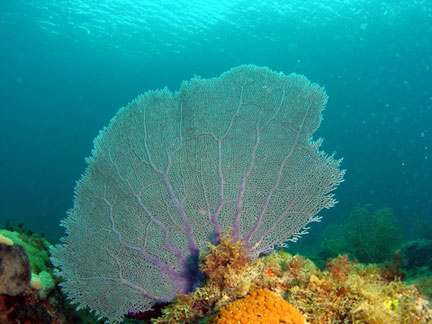
Fan Corals: (many lovely big ones on dive #1)
One of the stunning sunsets

Thursday, October 30, 2014

Day 2, Similan Islands Log

Gearing up to jump in!
Day Two on the Similan Diving Safaris liveaboard trip was as fantastic and jam-packed as day one. Here's where we dove:

Dive #1: Deep 6
Between Dive 1-2: Beach time! at Donald Duck Bay
Dive #2: Elephant Head Rock
Dive #2: Turtle Rock
Dive #4: Koh Bon night dive

At Donald Duck Bay, I decided to go snorkeling during the beach time. It was quite fantastic! I saw a huge school of large fish: they were teal blue on the nose and tail, royal blue on the belly, and orange striped on top. Some were the same species but a dark brown color... I think they might have been parrotfish, but I'm not sure. They swam in a big group of about 50, each fish was at least 1.5' long. Quite an amazing thing to be so close to such large fish.

I snorkeled near these rocks at Donald Duck Bay -
see the large rock and the resemblance to a duck bill?
There were also a number of other fish in the area, and without my scuba gear, which makes a lot of noise from the breathing apparatus, I could get much closer without scaring them. I saw bright bink parrotfish, a number of schools of silver fish that blended perfectly with the white sand and light-colored water, and numerous tiny crabs above the waterline that were terrified of me.

Devlin swam from the boat to the beach while snorkeling, so we swam/snorkeled back to the boat together. On the way, we passed over some dead coral patches. I don't know if it was caused by bleaching or by the 2004 tsunami, but as another diver describes these zones: "it looks like a bomb went off." The whole area was a huge circle of flattened and broken bits of brown-beige coral.

Around lunch time, one of the Thai girls spotted...Dolphins!  A large pod of at least 60-70 Southeast Asian bottlenose dolphins were moving past us. The captain sounded the airhorn, and we all went running to the bow of the ship to watch them. The captain circled the ship around to follow them, and they would swim along the front bow, occasionally leaping a bit at the surface. They were fantastically beautiful, and the glimpses we saw were so fleeting before they danced away from us again.

We learned from Ivan that there are other dolphin species near the Similans as well that they see, such as a spinner dolphins and other smaller species.

Other amazing moments of the day:
Divers waiting for the boat to come pick them up
On dive #1, at Deep 6, there were a number of "swim-through channels" - these were gaps/openings between the rocks that we swam through, kind of like mini tunnels! We swam through about 5-6 of them on the dive. During one, we saw Kate's group swim through, and then we passed through... Devlin and I were last, and as I turned to look around, I saw a turtle swimming quickly back to the swim-through to move away from us. It was a wonderful moment.

The variety of fish we saw throughout the day was staggering, and the list below reflects the beginnings of my attempts to understand the types. Did you ever know how many types of fish species there are? It's incredible. I spent a long while poring over the fish guides, coral guides, and other species books on the boat.

A Triggerfish - so big and neat to watch!
Sea Life Log:

Fish:
As on Day 1, saw many of these species: Blue Ringed Angelfish, Regal Angelfish, Powder Blue Surgeonfish, Moorish Idols, Lined Surgeonfish, lots of plain puffers and boxfish)
Butterflyfish: Long Nose, and others - hard to identify, they're all varieties of orange, white & black
*Picasso Triggerfish; Indian Triggerfish
Trumpetfish (dive #1, riding next to a large fish to hunt prey)
*Parrotfish: Bullethead, Yellow-tail, Black-veined
*Devil Scorpionfish (one on dive #3, sandy with red blotches, but it looked like a rock until it moved. We didn't know at the time, but it's quite poisonous! in the lionfish family)

A Parrotfish - they nibble the coral with their big beaky mouth
Snorkeling on Donald Duck beach: parrotfish swarm, brown and many with teal face, teal tail, dark royal blue belly, orange striped top (don't know species). Silver fish. Many puffers. Triggerfish and lots of little guys. So close to some pink parrotfish! Rocks above water had many little crab, very afraid of me. :-)
Tail-blotch lizardfish (many on the sand flats in various areas)
Robust fusilier (large schools on the coral reefs)
*Oriental Sweetlips (1 at a time, hiding under things)
Damselfish (family Nemo is in): Western clownfish (a couple groups), Eastern clownfish, Common humbug (or something like it, black with white stripes), 3-spot dascyllus
Long-nose unicornfish
*Speckled wrasse (dive #3, maybe this, it was very spotted)
* Adult rock-mover wrasse, looks like lionfish but mini size
* Long-nose unicornfish (one pair, way high up, dive #1)
Eels:
Giant Moray (4 on dive #1, 4 on dive #3 - two were in the same cave, one was free-swimming at the end of the dive!, 1 on night dive)
Sea Slugs & Related, & Shell-types:
*Pineapple Sea Cucumber (many - about 2-3' long)
Carnelian Cowrie shell (dive #2)
Crown of Thorns Starfish (dive #3)
Burrowing giant clam: a couple on dive #3
Ramose murex shells: many on night dive
Sea Urchins:
Black diadema sea urchin: zillions, especially on night dive - many very small ones, maybe 1-1.25" diameter, tucked into little rock pockets
Large black ones, purple tinge to main body, red-speckled feeding mouth (looked a bit like "Sauron's eye" to me) on night dive
One white one with olive green bits on night dive
Other Creatures:
Hawksbill Turtle

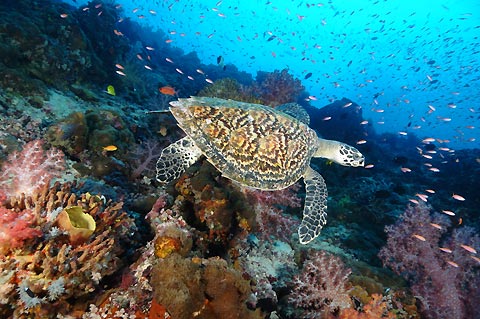
*Hawksbill Turtle (dive #1, escaped through the first pass-through cave); (dive #3, swimming away at the beginning of the dive, followed it for quite a while)
Kuhl's Stingray (dive #1)
Big Red Octopus (small one on dive #1)
*Jellyfish (on dive #1, tons that looked like clear translucent band-aids with a green eye)
Coral:
Staghorn Corals: Robust staghorn, Fine table corals (many),
Tube Coral (dark green, all over)
Soft coral: Hemprich's soft coral, Leafy soft coral (amethyst and red colors)
Some species identified: Mushroom leather coral (lots),
Fan Corals: Gorgonian (many many), Medium fan corals
Whip corals: beige and dark green

Monday, October 27, 2014

Day 1, Similan Islands Log

The "kids" listening to Ivan's briefing
Our first day with Similan Diving Safaris, with the crew of the M/V Dolphin Queen crew, started with a bang: a loud "ka-kaaw!" followed by "Wake up, time!" outside our door announced the early-rising call of our first day of diving. It was 6 am, and our first dive was at 7:15 am. Ivan led the briefing for the dive on Annita's Reef. A no current dive (meaning we wouldn't be pushed around by the ocean) - a good spot for everyone's intro dive off the boat.

Attentive listeners to the briefing
The experienced divers went first: our group, led by Mayumi, and Kate's group. Our gear was separated onto two sides of the boat: our group was on the right, Kate's on the left - this kept things from getting too chaotic, as it was a pretty tight spot with 10 divers trying to get on gear. The back platform was about 2' above the surface of the water (on a calm day), and had ladders for us to climb back on.
 
Here was the process: we each had a station where our tank was always placed, held steady by a bungee cord around the top. We would pull on our wetsuit and boots, then turn on tanks, then check air and dive computers. Next, we would remove the bungee cord around the top of the tank, sometimes with help from the three Thai "boat boys": Puh (pron. pooh), Chen, and Eee.
The right side of the boat, my tank is second from the left.

After tightening the straps on our BCDs, we would walk down onto the back platform, where one of the Thai guys (I can't call them boys), would strap on our fins. Then we'd wait for the airhorn blast from the captain signaling the "Ok!" to jump in.

With one leg outstretched, we would take a "giant stride" off the back and into the water, holding our regulator and mask in place.
And thus the dive would begin! The general schedule for the day was:

6-6:10 am: Wake-up Call; maybe eat a little something (banana and water), and listen to the morning dive briefing
7:15 am: Dive #1 (the first two days, our group and Kate's group went first, which meant we really were down and getting ready by 7 am)
9 am: Back on the boat, gear put away and tank off; then upstairs for breakfast. Western style breakfast, which meant our choice of fried eggs, scrambled eggs, or omelette; sausage and ham; and pancakes/french toast. We would order the breakfast the night before on a clip board, as the Thai cooks would get up by 4:30 am to start the prep.
11 am: Dive #2, briefings 20 min. before
12:30 pm: Thai style lunch, buffet style, and always fantastic
3 pm: Dive #3
6 pm: Thai style dinner
7:15 pm: Dive #4, sunset or  night dive
8:30 pm to 9:30 pm: Bedtime

And rinse and repeat the next two days. Day #4 would have only 2 dives in the morning before we began our return to Khao Lak. A grand total of 14 dives in 3.5 days!

The rest of the dive team were: Sofie, leading two brand new divers; Ivan, leading two younger Thai kids on their first certification dives, as well as the daughter of Similan Diving Safari's owner, Joe; and photographer Tom, who took pictures of all the divers and fish throughout the trip.
Dive site locations!

The Thai crew also included: Captain Ik (pron. "eek"), and head cook Ya, and prep cook Ling. The Thai crew worked like crazy all day; someone always seemed to be washing dishes or chopping food. The boat boys/guys did a great number of tasks all day: they took our fins from us at the end of the dives so we could climb back up the ladders, and then they would be filling the tanks for our next dive; then washing dishes; or manning the motor boat to take us to local beaches.

They did get some down time too: among the guests, we had five Thai teenagers, and they and the boat guys would play around with the kayak, or diving off the boat, or hanging out in the Captain's quarters playing loud American pop music. (I still have one or two of those songs stuck in my head! Fun addictive music.)

Here's where we dove on Day 1:
Dive #1: Annita's Reef
Dive #2: Stonehenge
That's me, pretending to be Indiana Jones
Dive #3: West of Eden
Dive #4: Night dive, around Island 4

We also got to visit a beautiful beach between Dive #1 and #2, and a big group of us decided to walk up to the viewpoint on the island. It was quite a trek, and all the divers except me were barefoot and mostly wearing swimsuits. There were a lot of mosquitoes, too!! It became an Indian Jones-like endeavor at the end, complete with rickety-looking ladders over a small crevasse, ropes to pull us up slippery wet slopes, and at least four very steep and sketchy ladders. The view was pretty good, too - but the climb was really the adventure!


Sea Life Log: 
Fish:
One giant solo Tuna
Coral Rock Cod (many)
Humpback Unicornfish (2)
Moorish Idol (lots)
Picasso Triggerfish (3-ish)
Western Clownfish (2 groups)
Singapore shrimp goby (many)
Parrotfish, a bunch of different types, all cool colors (see Day 2)
Wrasses: Yellow Moon, Adult Napoleon (big!), others
and many, many, many others
Eels:
Giant Moray Eel (2)
Spot-face Moray (night dive)
Lionfish:
Pacific Lionfish (4)
Spotfin? lionfish (dark and silvery banded, on night dive)
Puffer & related fish:
Seal Faced Puffer (lots)
Giant Pufferfish (1)
Spotted Boxfish (1)
Surgeonfish:
Horseshoe surgeonfish
Powderblue surgeonfish (sometimes a pair would circle around each other and spiral up for a while, like a little dance)
Sea Slugs:
Ocellated Wart slug (1)
Pineapple Sea Cucumber (1, so big!)
Marbled Sea Cucumber (many big ones)
Shrimp & Crustaceans:
Coral Banded Cleaner Shrimp (tons, on night dive - you see their pink eyes glow)
Painted Spiny Lobster (1 that was wedged under a rock, with long white antennae)
Harlequin Shrimp (night dive)
Peacock Mantis Shrimp (night dive)
Durban Dancing Shrimp (night dive)
Magnificent Partner Shrimp (night dive)
Other Creatures:
Green Turtle (Devlin saw it before it swam away, on dive 3)
Blue Sea Star (1 on night dive)
Black Diadema Sea Urchin (many on night dive)
Christmas Tree Worm (tons)
One unidentified big red crab (on night dive)
Octopus (one white-ish one, Dev saw at end of night dive)
Corals:
Gorgorian Fan Coral (lots)
Long Arm Feather Star
Orange Straight Sea Whip
Hard Coral (lots)
Magnificent Anemones
Compact Coral
Octocoral
Maze Coral
Fine Table Coral
and many, many others

Saturday, October 25, 2014

Similan Diving Safaris - Liveaboard!

Walker's Inn, the orange building, in Khao Lak
Six days ago we arrived in Khao Lak, a small beach town in Thailand that is the starting point for many liveaboard trips to the famous Similan Islands. The Similans are a chain of nine islands that form a National Marine Reserve area. To the north is another famous chain, the Surin Islands.

We'd negotiated a cheap-er taxi ride (200 baht, instead of 300-400, or $6 instead of $8-10) after walking a little ways from Phuket Airport. Compared to our visits to Cambodia, and somewhat to Vietnam, the local taxis, minibuses, and other point a to point b transports are a rip-off scam. Many drivers will pretend that there are no government buses that run to other towns, such as Khao Lak, and will try to convince you that it is best to go with them instead (often for 5-6 times more the cost). A minibus from the airport would have cost us about 600 baht per person, or $18; the government bus was 200 baht total ($6!).

Dive locations in the Similan Islands
After that, the bus ride was pretty uneventful. We almost jumped off too early, when we thought our GPS said we were further along - but thankfully, we stayed on until the actual town. (Sometimes you need to be sure your equipment is functioning properly.) :)

Khao Lak sits at the edge of a National Park, the Khao Lak / Lam Ru National Park. Imagine this: two to three-story guest houses off the Main Road (e.g. Hwy 402), and above that, masses of jungle and trees climbing steep hills. The air was moist and damp, and we had frequent rain showers when we arrived, adding more mist and cooling things off somewhat. In between, the sun would break through, and suddenly it was swelteringly hot. And this is a pretty cool time compared to the hot season, from February through April.

We bunked up at Walker's Inn, a very cheap but pleasant guest house right off the main road. It's a big orange three-story building, and we had a nice squeaky but comfy king-size bed with a private shower/toilet. The room was 500 baht/night total, or about $12. It's sometimes hard to find beds that aren't rock-solid hard - we always ask to see the room, and the softness of the bed is a big deciding factor. The other main factor is good wifi signals in the room.

Similan Diving Safaris main office in Khao Lak
Walker's also had pretty good and inexpensive Thai food, served in the bottom floor restaurant. Other foreigners at the restaurant told us they often went to Walker's for meals as they had one of the best wifi spots in town.

After our first lunch at Walker's (pad thai and tom kha soup - both pretty good), we headed into town to talk to the scuba shops about a liveaboard trip. We talked to three shops: Khao Lak Explorers, Khao Lak Scuba Adventures, and Similan Diving Safaris (in that order). We skipped Wicked Diving entirely, although they were top-rated in my guide book - their prices started at almost $1,000 - more than other shops.

The M/V Dolphin Queen, one of Similan Diving Safari's 2 liveaboard boats
We decided on Similan Diving Safaris because of a number of criteria:
1) Experience: they are the oldest shop in Khao Lak, 18 years old

2) They owned their own boat and ran the whole operation. Many other shops (both 
Khao Lak Explorers and KL Scuba Adventures, and many others) are basically "booking agents" - they don't own the boat you go out on, or manage the crew operating it. You book a bunk, and maybe get a dive guide from the shop. It's a bit nebulous. You can tell because the ships all have the same names: Manta Queen 1, 2, 3, and 7.

By contrast, Similan Diving Safaris (SDF), owns two boats: the Dolphin Queen and Similan Explorer. They pay their Thai crews well and have excellent dive master guides. They generally try to have smaller groups per guide - usually 4 divers per guide. Other shops put 5 divers per guide typically.

Boarding the Dolphin Queen! No the wreck is not it ;)
3) A Good Deal: when we talked to SDF, the owner of the shop happened to be there. Joe (coincidentally, the same name as our friend Joe in Japan!), told us all about the boat we'd be on, and then offered us a sweet deal: if we got on the next day's trip, a 4 day 4 night trip, he would give us the last Private Double bed for the same price as the general bunk bed cabins. We also got a discount for having our own gear (except tanks & weight).

4) Guest feedback: As we were leaving to think things over, the guests from the first season's boat trip returned to the shop. We got some great feedback from a lady named Lynn from Colorado. They'd had a great time with SDF and recommended them highly.

There she is, the Dolphin Queen
After considering Devlin's work schedule and the above criteria, we went with SDF on their next day's trip: a 4-day, 4-night trip to the Similans on the M/V Dolphin Queen. The next day at 11 am, we dropped off our scuba gear to be loaded on the boat. At 3:30 pm, we were loaded onto minibuses and headed to a main port about 10 minutes from Khao Lak. The boat sailed all the rest of the evening and part of the night to reach the Similans.

More in the next post about our first day of diving, and what we saw!
Our double bed room on the Dolphin Queen - cozy!
The main eating and hang-out space on the ship

Sunday, October 19, 2014

Arrived in Phuket & Contrasts

A guard statue at Bangkok Airport
Thailand! It's 9:30 a.m. in Nai Yang town, and I'm sitting outside our little room at the Airport Bed & Breakfast, breathing in the moist air in the 80-ishF heat. I think it's about the same temperature as last night when we flew in from Bangkok at 9 pm last night. When we left the air conditioned sanctum of the airport, my glasses fogged up immediately in the humidity.

It's not unpleasant, breathing in this moist, rich air. At our little B&B right now, we're a ways out from the main area, and the area is filled with trees and lush greenery. It's a bit like breathing in the air in a cool-ish greenhouse, and the scents of the plants are lovely. Japan doesn't have enough greenery for me.

Last night after landing at Phuket International Airport, we strapped on our bags and started walking the 2 km (it was about a 20 minute walk) to the B&B. It is always a shock when you transition between countries, especially two countries as different as Japan and Thailand.

A giant statue at Bangkok Airport
Japan is an impeccable country - rarely do you find any uneven sidewalks, dog turds, unlit areas, or lack of pedestrian crossing areas. By contrast, the minute we left the Phuket airport, we were traversing around large holes in the sidewalk (or even crevasses), smoggy traffic, and lounging taxi drivers. Our walk to the B&B took us down increasingly dark roads, until we were wishing we knew where our headlamps were buried in our bags.

It's different. Not bad, just different.

It was also a pleasant difference from Japan to be surrounded by foreigners. The minute we entered Bangkok airport, we were no longer a minority. Foreigners of every type and description filled the teeming airport. There were even some very interesting groups of women and men from a middle eastern country - I have no idea which one. The men were all dressed in a traditional trouser and tunic garb, and the women were head-to-toe in black burkhas. Very mysterious.
The door to our little bungalow room at Airport B&B

I think the number of identifiable foreigners (including ourselves) that we saw while in Japan would be under 15. We had a great time in Japan, but after a while, I get tired of standing out. It is also very strange to be here in Thailand and to use English to get around as well - my Japanese improved immensely during the past two weeks.

Today we will catch the bus up to Khao Lak, a beach town further north, and the jumping off point for many liveaboard diving trips to the Similan Islands. I am so excited to have our first Thai meal today! Spicy food, here we come.
Airport B&B
The entry area at Airport B&B
Veranda of Airport B&B

Tuesday, October 14, 2014

Diving on Yonaguni Island

In between typhoons, we did manage to have one great day of diving on Yonaguni Island! The rest of the days, the blustery wind made the surface conditions too rough to go diving. But the day after we arrived, it was a good day to dive. We were staying at Yonaguni Dive Service (YDS), which has a nice guest house attached to the dive shop. Makes it very convenient!

We were up at 7:30 a.m. for breakfast in the dining area. Besides Devlin, myself, and Joe, there were also four other visiting divers from other parts of Japan staying at the YDS. We were also accompanied by three other dive staff of YDS.

By 8:45 a.m., we were all dressed for Dive #1 in our wetsuits and our gear had been loaded onto the YDS boat in the main harbor. We clambered aboard, and everyone grabbed a tank and started prepping gear. Once all the gear was prepped and ready, off we went out of the harbor and to the first dive site. Our dive master, Ookii-san (oh-key-sahn), told us that it was too rough seas to dive at the Yonaguni "Ruins" site, so we were going to a calmer coral reef that had less currents.

And it was a pretty calm dive. At the start I had some trouble with my BCD (buoyancy control device) at first, after that got straightened out the dive was quite nice. Joe had some trouble with his BCD too, but we still saw a lot of fish and went through a neat cave passage-way between reefs. There were so many fish it was hard to focus on any one in particular - in all directions there were just so many.

Getting back in the boat was exciting - we would all surface together, and then at Ookii-san's signal, we would swim to the boat. It had a huge ladder, three-people wide, and we would scramble in as fast as we could with flippers on. Due to Yonaguni's fast currents, this is the best way to get on the dive boat - otherwise, the boat would drift away from the divers, and if we took our fins off before getting on, they could be easily lost by the fast water.

We returned to YDS for lunch. Dive #2 was at 1 p.m., and we were on the lookout for schools of barracuda. It was a drift dive in a faster current spot, so we didn't have to do much swimming - the current smoothly pulled us along. At Ookii-san's signal, we would all sink to the ground and hold on to rocks to watch for barracuda. We didn't see any that dive, but Devlin saw a big eel, and we saw oodles of fish. 

It was really cool to look around and see all the other divers, with their streams of bubbles floating up. It's an incredibly different world to be in. Our underwater world was comprised of the hills and valleys of the coral reefs, and hanging above them, seemingly weightless, were the countless schools of tropical fish.

At 3:30 p.m., it was time for Dive #3. We went back to the same spot as Dive #2 in attempt to see barracuda again. We didn't have any luck there, but we did see some other great things: a big purple & orange parrotfish that was industriously moving sand & coral around (maybe to lay eggs?); the ghostly image of some really really large fish far away... Ookii-san said they were unicorn fish. Devlin could see the horns but I couldn't see quite that far. And we were visited by one larger and very curious silver fish, that moseyed through our group of divers and then leisurely swam away.

After three dives, we were all absolutely exhausted. We were all falling asleep at dinner at 6pm!

Joe plans to return to Yonaguni another year, when it isn't typhoon season. To see the Yonaguni ruins, the water needs to be quite calm. And, we are told that schools of hammerhead sharks come through between January to March to mate, so that is also a very good time to visit the island!

Sunday, October 12, 2014

Joe arrived back in Ishigaki

Joe has finally made it off of Yonaguni Island and has returned to Ishigaki! All flights yesterday were cancelled, and so he could get a flight at last tonight at 6 pm. On Tuesday we will all return to Fukuoka, and then to Oita. Hopefully, Typhoon Vongfong won't cause any flight delays for us on Tuesday... we'll find out.

Looks like Typhoon Vongfong has slowed down a lot, but for a while it looked like it was going to be a whammy of a storm when it hit Okinawa. It was the strongest storm on earthfor 2014 until just a day or so ago, and now it's slowing down. Category 5 hurricane winds, the strongest hurricane level, with wind speeds of 180+ mph.

We've been watching it with great interest here, of course, as the winds have been felt here in Ishigaki too. Even though we're a long ways west and south of the Okinawa islands, which bore the brunt of the storm, we're still getting some pretty blustery winds as well.

We hope that the Typhoon won't cause too much damage - mainly flooding or land slides - to mainland Japan.

Thursday, October 9, 2014

Safe from Typhoon Vongfong

We interrupt this regularly scheduled broadcast...
So, there's a typhoon coming. I'm sure you already know that, but it's been quite exciting here. We missed the previous one, Typhoon Phanfone, because it passed farther to the east of the Okinawa islands and mainly impacted mainland Japan.
It's 6 p.m. now, and we're waiting at Yonaguni Airport on stand-by to see if one of us gets off the island. Our original plan was to take the ferry back to Ishigaki, which leaves on Saturday. However, the ferry is the most likely transport to be canceled due to bad weather. The flights can continue much longer before they're interrupted by the weather.
We decided to get off the island yesterday evening, as we saw the news of the typhoon worsening. There weren't 3 seats available all together, so we booked seats for a Saturday flight. However, today we couldn't go diving as the surface conditions made it impossible (or very, very rough and a really tough re-entry on the boat). So, after seeing the wild ponies on the island, here we are at the airport, waiting to see if one of us can get out.
------------------------------
Flash forward to 10 p.m. There were two seats available on the airport, so Joe elected Devlin and I to fly out. Our plane ride was just fine - smooth most of the way and a little bumpy on landing. The planes through the islands are a type called DHC-8, which Joe says are a very reliable and sturdy plane. They have a propeller jet engine on each side, and a maximum of 39 people + flight attendant (we counted tonight).
We caught the #4 bus in to Ishigaki port from the airport (the #4 and #10 lines go there), which is about a half hour ride. Then to Yaima Biyori, the inexpensive pension guest house we stayed at before we left for Yonaguni. After a wonderful meal at Daimyo, a local restaurant our guest house recommended, we are ready to crash to sleep. Joe should be able to catch a stand-by seat tomorrow, either the 9:45 flight or 12 pm flight, and then we'll all be a-ok and safe from the typhoon's wrath!